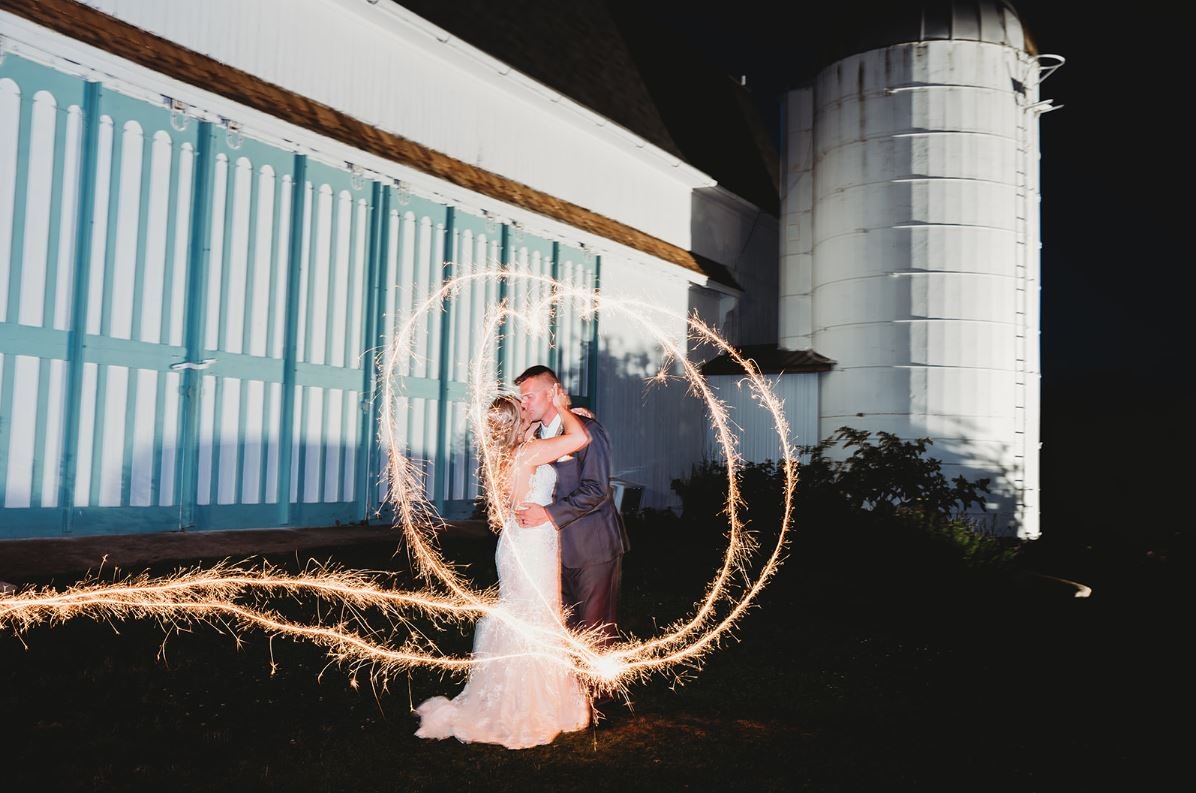
Ten years ago, a Rochester couple booked a photographer and got a shot list. Two hundred names on it. Bride with grandmother. Groom with college roommates. Rings on a windowsill next to a folded invitation suite. The day was built around producing those images.
That model is fading fast across Upstate New York. Couples booking 2026 dates are asking a different question at their consultations: not “can you get this shot,” but “will you stay out of the way.”
Documentary wedding photography answers that. It means the photographer shoots what happens instead of building what should happen. No hand-on-hip corrections. No “look at each other and laugh.” The photographer reads the room, predicts the moment, and presses the shutter before anyone knows they were watched.
Here’s why it’s spreading through Rochester, Buffalo, Syracuse, and every farm venue in between.
The Guest Count Dropped and the Photography Style Followed
Upstate weddings shrank. A 250-person ballroom reception used to be standard for a Monroe County family. Now the median guest list sits far lower, and couples are spending the savings on food, music, and the people who document the night.
Smaller rooms change everything about how a camera works. At 90 guests in a converted barn outside Canandaigua, there’s no stage separating the couple from the crowd. Aunts are three feet from the first dance. A photographer who stops the action to pose a group breaks something that can’t be rebuilt.
So the style adapted. Fewer setups. Longer lenses at the ceremony, wider lenses at the party. More waiting.
Intimacy Reads Differently on Camera
A posed portrait of two people in a field tells you they hired a photographer. A photo of a father wiping his eyes during a toast, taken from twelve feet away with a 50mm lens, tells you what the night felt like.
Couples are noticing that difference in their friends’ galleries. When the images that get printed and framed are consistently the unposed ones, the booking behavior shifts. That’s the actual mechanism behind the trend. Not a magazine declaring it. Word of mouth in a mid-sized market.
What Documentary Coverage Actually Looks Like Hour by Hour
Vague style descriptions cause booking regret. Here’s the concrete version, mapped against a traditional approach.
| Part of Day | Traditional Approach | Documentary Approach |
| Getting ready | Dress hung on a window, rings staged on a book, bridesmaids posed with champagne | Real hair and makeup, the mother lacing a dress, someone crying at a letter |
| First look | Directed reveal with marks on the ground | Couple picks the spot, photographer stands back with a long lens |
| Ceremony | Photographer moves freely, sometimes up the aisle | Two shooters locked to fixed positions, minimal movement, no flash |
| Family photos | 30 to 40 combinations, 45 minutes | 8 to 12 combinations, 15 minutes, then back to the party |
| Reception | Staged cake cutting, posed table visits | Toasts, dance floor, the uncle asleep in a chair at 10:40 |
| Exit | Re-staged sparkler run, sometimes twice | One take, whatever happens |
The middle column isn’t wrong. It produces clean, predictable albums. It also produces 400 images where everyone knows a camera is present.
The Family Photo Compromise Nobody Talks About
Pure documentary shooters who refuse all posed groups create a problem. Your grandmother wants a photo with you. Your parents paid for part of the day and would like a picture where everyone is upright and looking forward.
The photographers winning bookings in Rochester and Buffalo right now handle this with a short, ruthless list. Ten groupings, named in advance, with a family member assigned to round people up. Fifteen minutes, done. Then the camera goes back to observing.
That hybrid is the real 2026 standard. Anyone selling you “100% candid, zero posed” is selling an ideology, and you’ll hear about it from your mother for a decade.
Upstate Venues Reward Photographers Who Wait
Geography matters here more than people admit.
Western and Central New York weddings happen in rooms with character and bad light. Century-old churches with deep pews. Barns with string lights and dark corners. Downtown Buffalo lofts with three windows on one wall. Ski lodges at Bristol and Swain. Lakeside tents where the wind moves everything.
These spaces punish photographers who rely on setups. You can’t pose your way through a Letchworth ceremony when the sun drops behind the gorge wall in eleven minutes. You can’t stage a moment in a Buffalo church where the pastor has told you to stay behind the last pew.
You can, however, wait. Read the light. Know that at 6:40 the sun clears the treeline and hits the tent’s north side. Be standing there when the couple walks through it.
Weather Forces the Issue
Upstate weather does not cooperate with plans. A June ceremony in Rochester can start under clouds and end in direct sun. Lake-effect systems off Ontario and Erie roll in with an hour of warning. October in Buffalo has produced snow.
Photographers who build a day around scheduled portrait blocks lose those blocks constantly. Documentary shooters treat weather as content. Rain on a tent. Guests crowded under an overhang. A veil taken sideways by wind off the lake. Those frames end up in the album because nobody was trying to prevent them.
Couples working with a Rochester Wedding Photography team that shoots this way tend to describe the same relief afterward: the day never stopped for photos, so nothing got lost when the forecast turned.
The Skill Gap Is Real
Here’s the part the trend articles skip. Documentary photography is harder, and a lot of people offering it can’t do it.
Posing is a safety net. If you can arrange two people in good light and give them instructions, you will produce competent images at every wedding, forever. Remove that net and you need three things at once: anticipation, technical speed, and the nerve to hold a frame while nothing is happening.
Anticipation Is the Whole Job
Good documentary shooters watch hands and faces, not the main action. The bride’s sister starts to cry ten seconds before the toast lands. The groom’s father reaches for a handkerchief before he needs it. A photographer tracking the speaker misses both.
This is learned by shooting hundreds of weddings and remembering the pattern. It isn’t a gear question. A $6,000 camera doesn’t tell you which grandmother is about to stand up.
Technical Speed Under Pressure
Reception lighting in a Buffalo banquet hall changes when the DJ hits the lights. A documentary shooter is adjusting exposure by feel while walking backward through a crowd. Miss it by two stops and the moment is gone, because there’s no second take.
Ask any photographer you’re considering how they handle exposure in mixed light. If the answer is “I fix it in editing,” keep looking.
The Nerve to Do Nothing
Newer photographers fill silence. Twenty minutes without a shot feels like failure, so they start directing. Something something, stand here, hold hands.
Experienced ones sit down.
How to Tell Real Documentary Work From a Marketing Word
Every portfolio in Western New York now says “candid” and “unposed.” Most of them aren’t. Use these checks.
- Ask for one full gallery, start to finish. Highlight reels hide everything. A real gallery shows you the boring stretches and whether the photographer found anything in them.
- Count the eye contact. In genuine documentary work, most subjects aren’t looking at the lens. If 70% of the gallery has people staring into the camera, it’s posed work with a candid label.
- Look at the backs of heads. Documentary galleries include imperfect angles because the moment mattered more than the composition. Zero imperfect angles means heavy curation or heavy direction.
- Check the reception. This is where styles separate hardest. Posed shooters produce table portraits. Documentary shooters produce dance floors, kitchen conversations, and the bar at 11pm.
- Read reviews for the word “invisible.” Couples say it unprompted when it’s true.
What You Give Up
Honest version, because pretending there’s no tradeoff is how couples end up disappointed.
| You Gain | You Lose |
| Images that show what the day felt like | Predictable magazine-clean portraits of every detail |
| A day that runs without long photo stops | Control over exactly which shots exist |
| Natural expressions from people who hate cameras | Some flattering angles that posing would have fixed |
| Coverage of moments you didn’t witness yourself | The predictability of a shot list |
| Faster family photo sessions | Certain traditional groupings, if you cut the list too far |
If you need a specific image, say it out loud during booking. Documentary photographers will get it. They just won’t build the day around it.
Pricing Moved Too
Coverage length changed alongside style. Traditional packages were built around blocks: two hours of portraits, one hour of family, four hours of reception. Documentary coverage is continuous, so hours matter more than deliverables.
Across Rochester and Buffalo, eight hours has become the common floor for 2026 dates, with ten hours booked often enough that many photographers now list it as the default. That’s not upselling. It’s the style requiring presence.
A documentary shooter who arrives at 2pm for a 4pm ceremony misses the getting-ready hours where the best unguarded frames live.
What Eight Hours Actually Covers
Couples underestimate how fast the day compresses. Here’s a realistic Upstate breakdown for an eight-hour documentary booking with a 4:30 ceremony.
| Time | What Happens | Why It Matters to the Camera |
| 1:30 pm | Photographer arrives, hair and makeup finishing | Quiet room, soft window light, real conversation |
| 2:15 pm | Dress, jewelry, letters, parents entering | The highest concentration of unguarded emotion all day |
| 3:15 pm | Travel to ceremony site | Car interiors, nerves, texts between the couple |
| 4:00 pm | Guests arriving, couple hidden | Second shooter covers arrivals and the other partner |
| 4:30 pm | Ceremony | Fixed positions, no movement, longest lenses of the day |
| 5:10 pm | Family groups, short list | Fast, named, over in fifteen minutes |
| 5:30 pm | Couple portraits and cocktail hour | Split coverage, one on the couple, one on guests |
| 6:30 pm | Dinner and toasts | Reaction faces, not the speaker |
| 8:00 pm | First dance and open floor | Flash comes out, energy peaks |
| 9:30 pm | Coverage ends | Late-night frames need a ten-hour package |
Look at that 2:15 line. Two hours before anyone is officially “on,” and it’s where documentary coverage earns its keep. Cut those hours to save money and you cut the exact material this style exists to capture.
One Sentence on Second Shooters
For a documentary approach, a second shooter isn’t a luxury, it’s the only way one camera can be on the aisle while another is on the parents’ faces.
Where This Goes Next
The trend has a natural ceiling. Not every couple wants it, and not every family will accept a twelve-photo group list. Big traditional weddings in Buffalo’s larger halls still book classic coverage, and those photographers are busy.
What’s changed is the default. Ten years ago you had to ask for documentary work and pay a premium for a specialist. In 2026 across Upstate New York, it’s the assumption, and posed coverage is what gets requested specifically.
That’s a real shift, and it came from couples, not from photographers.
Conclusion
Documentary wedding photography grew in Upstate New York because it fits how people are actually getting married here now. Smaller guest lists. Venues with character and difficult light. Weather that ruins schedules. Couples who don’t want to spend ninety minutes taking direction on their own wedding day.
Before you book, do three things. Ask to see a complete gallery instead of a highlight set. Agree on a short family photo list in writing so nobody is surprised. Book enough hours that the photographer is present for the parts of the day nobody plans. The style works when the photographer is skilled enough to disappear and confident enough to wait. Hire for that, and the images will sh